Loft Conversion Regularisation in March
Need loft conversion regularisation in March? Start with a free phone consultation. Guide cost is £1,600 to £26,600 including VAT and the usual timescale is 2 to 8 weeks from survey to certificate.
- Free home survey
- Fixed written quote
- Drawings and engineer included
- Building control handled
- UK-wide teams
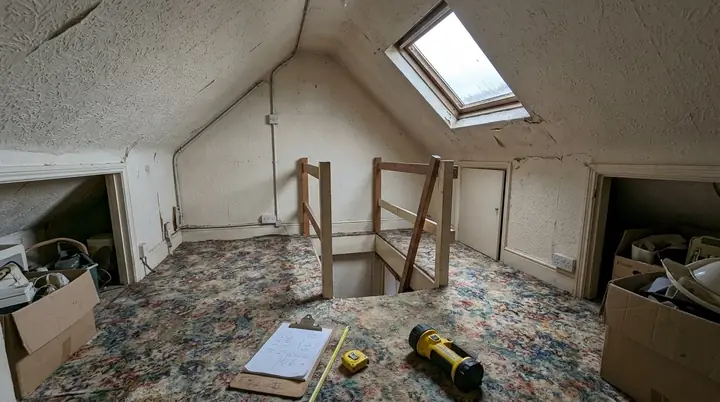
Loft Conversion Regularisation for homes in March
As a town in Cambridgeshire, about 14 miles from Peterborough, March has a mix of house types, and the right loft design depends on the roof you have.
Post-war estates and newer developments mean trussed rafter roofs come up often, alongside 1930s semis nearer the town centres.
What does loft conversion regularisation cost in March?
In March the guide cost is £1,600 to £26,600 including VAT. The lower figure covers survey, drawings or assessment and applications only; the upper figure applies where more work is needed. Council fees are charged at cost.
| Guide price in March | £1,600 to £26,600 inc. VAT |
|---|---|
| Typical duration | 2 to 8 weeks from survey to certificate |
| First consultation | Free |
Key facts
- Common defects are undersized floor joists, steep or ladder stairs, no fire doors and no linked smoke alarms.
- Without a certificate the room is normally described as loft storage, not a bedroom, when the house is marketed.
- Regularisation applications in England and Wales are made to the local authority building control and apply to work carried out after 11 November 1985.
- Some plaster or flooring usually has to be opened so structure and insulation can be seen.
Why use us in March?
- Drawings and calculations are yours to keep and use.
- Structural engineer's input included.
- Fixed fee agreed in writing before chargeable work starts.
- Carried out by a company that builds lofts, so the advice is practical.
Planning and building control in March
Regularisation deals with building regulations; if the original work also needed planning permission, that is checked separately.
In England most loft conversions on houses are permitted development: the added roof volume must stay within 40 cubic metres on a terraced house or 50 cubic metres on a semi-detached or detached house, nothing may sit higher than the existing ridge or project forward of the roof slope facing the road, and materials must be similar in appearance. Flats, maisonettes and houses on designated land such as conservation areas do not have these rights.
Building regulations approval is always needed. Building control checks the structure, fire safety, stairs, insulation, ventilation and electrics and issues a completion certificate at the end.
How the work runs
Visit and measured inspection
A surveyor visits to measure the loft and record its structure, stairs and fire protection.
Fixed fee in writing
You receive a written scope and fee before any chargeable work starts.
Drawings and engineer's input
Plans are drawn and a structural engineer provides calculations or an assessment.
Outcome
You receive the approvals or the completion certificate, plus a clear list of anything still to do.
Loft Conversion Regularisation in March: your questions
How much is loft conversion regularisation in March?
Our guide price in March is £1,600 to £26,600 including VAT. A fixed quote follows a survey of your loft.
Will a loft conversion suit my house in March?
Most houses can be converted. The checks are head height under the ridge, roof pitch, the type of roof structure and where the stairs can go. We measure all four at the survey.
Who deals with building control in March?
We do. We make the application, book each inspection with building control and hand you the completion certificate at the end.
How much does it cost to regularise a loft conversion?
Survey, engineer's assessment and the application typically cost £1,600 to £3,500 including VAT plus the council's fee. Remedial work, where needed, can take the total to £26,600 or more for a floor and stair rebuild.
What will building control look at?
Floor strength, the staircase, fire separation and escape, smoke alarms, insulation, ventilation and electrics.